

Paper chain: Finland
Interesting Conflicts
During my work on sustainable timber and paper supply chains, I worked regularly in Finland, both for Finnish forest companies and for major customers.
During the first years of the new millennium, some interesting conflicts developed between Finnish forestry, NGOs and German customers. There was growing irritation on the part of Finnish forest owners about the increasing influence of young urban intellectuals from Western and central Europe (Greenpeace, Friends of the Earth, ...) who were interfering with Finnish feelings of ownership and autonomy. What made the situation even worse was that German paper customers were making coalitions with these NGOs, including Greenpeace. The situation became very emotional and political. Even the Finnish Embassy in Berlin and the German Embassy in Helsinki were involved in a high level conflict.
Finnish Farmers - Global Markets
At hindsight, the following developments and contexts came together in this particular series of events:
- Finland's opening to the European and global markets. After a long time of relative isolation and strong dependence on Russia and Sweden, Finland was becoming a European and global player. Even forest owners became exposed to global markets, including global citizens.
- Finnish paper companies did not have much experience with market communication. Even marketing was something relatively new in the late 1990s. The older company elite consisted of intelligent technocrats who were not trained to deal with Greenpeace and similar organisations.
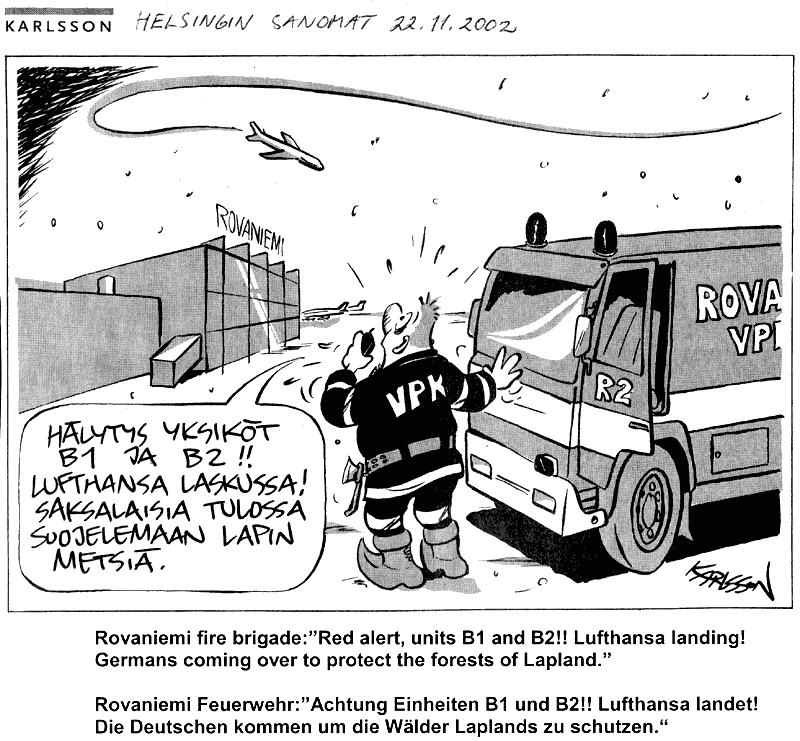
- Finland had been hit very hard by the second world war and there were still bitter sentiments against the Germans. Germans threatening the freedom of Finnish forest owners (this time not by war but by sustainable forest certification) was the last thing the Fins would accept. Allegations to the second world war, made in an ironic caricature in a Finnish newspaper, were taken (much too) seriously by the Germans. If their reaction had been a bit milder, the conflict would not have developed at all.
- The conflict was used by German paper customers for their own advantage. In Finland, they created an ideal stage for playing the good guys, aligning with environmental NGOs and creating pressure on their suppliers. This again added to the high energy level of the game.
I was asked to play a role in studying the situation and facilitating some meetings. This project was one of the most interesting - and sometimes hilarious - projects I ever did.
A Different World
More than eight years after this project, the conditions are very different. It is very unlikely that such a situation will occur again. The context has been changed radically:
- The process of globalisation has progressed much further. Changes in Russian forestry policy actually helped the process accelerate. Decreasing availability of low cost Russian timber has made Northern Finnish forest industry even less profitable than it was before, leading to the shut-down of mills like the Kemi pulp mill. Finnish forest industry has created new pulp capacities in the Southern hemisphere (Uruguay, Brazil, ...). Local forest owners and Finnish forest industries do no longer share the same interests.
- Finland is no longer the playing ground for European publishing companies for promoting their sustainability image. The show is over.
On the left-hand side of this page, you will find some links to some historically interesting documents, which, however, are not very relevant for the discussion today.